Showing posts with label How to Write. Show all posts

February 10, 2014

Plot Talk #2: The Dreaded Cliffhanger!

Oh cliffhangers...what a plot device! The bane of my reading existence and yet the joy of my writing existence :)

I know, I know, how does that make sense? Let me explain...

As a reader, I'm all:


But as an author, I'm all:
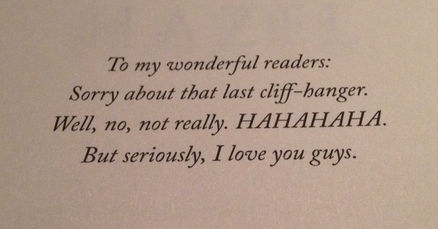
(As explained by the wonderful Rick Riordhan!)


When it comes down to it, cliffhangers are fantastic plot devices! Sure, they annoy the heck out of readers (especially cliffhangers at the very end of a novel), but they are extremely useful. 

I normally boil cliffhangers into two basic categories--short-term cliffhangers (my favorite to use) and long-term cliffhangers (the ones that drive people crazy). 


Short-Term Cliffhangers

I define short-term cliffhangers as chapter-to-chapter cliffhangers. 

You're reading, enjoying, laughing with the character, when suddenly she comes face to face with her crush, they talk, he leans in, she catches her breath, then BAM--chapter ends. Or more high-stakes--your hero is exploring an empty castle, he hears a sound, turns, his eyes go wide, there's a sword at his throat, then BAM--chapter ends. 

There go your plans to go bed at the end of the chapter! You NEED to keep reading so you can find out what happens. And since it's the middle of the book, you can! 

These are my favorite cliffhangers to use! Here's why:

1) Can't stop syndrome! When done right, your reader won't be able to stop him/herself from turning the page and starting the next chapter. This just heightens that amazing "couldn't put it down" feel to reading--my favorite! 

2) Immediate gratification! Your readers don't have to wait months to find out what happens, they get the answers right away. 

3) Creates tension! My favorite books contain oodles and oodles of tension--high stakes, lots of pressure, a ticking time bomb. Using internal cliffhangers can help keep the pace quick and emotions high.

I found this technique especially useful in my new book The Shadow Soul because it is told through two different character perspectives. Using these short-term cliffhangers I hope kept the pace quick for both tales, while also keeping the readers emotional invested in the states of both characters. 


Long-Term Cliffhangers

I define long-term cliffhangers as those that happen at the very end of the book. 

You're reading, speeding through the pages, and the end of the novel is coming to a climax. You can feel the pages thinning and know there isn't much time left. The hero meets the villain, they share words, a fight commences. Your hero is thrown down, the fate of the world rests on his/her shoulders, you greedily turn the page to see how it all ends...and NOTHING!

The next page is blank, the page after that contains the title of the sequel and an on-sale date that is A YEAR away. A long, long time. 

Let's face it--if an author is writing a series, these cliffhangers are somewhat unavoidable. You want the readers to keep reading, you want to hold their interest, so you can't give the entire story away at the end of the first book--no one will come back for more! HOWEVER, I think there is a right way to do this and a wrong way. 

To me, the right way is for each individual book to have its own thematic arc that comes to a close at the end of the novel, but the overall story still has open threads that keep the reader invested. Take Harry Potter for example--the titles tell you what the thematic story for that book is going to be. Prisoner of Azkaban. Goblet of Fire. Each book has it own story. But, the overall fight against Voldemort carries on and it keeps readers invested in the lives of the characters and the fate of the world. 

To me, the wrong way to use a long-term cliffhanger is to completely leave your readers in the lurch--a filler book. I understand why authors do it, but I can't shove my reader side far enough way to let myself write something like that. Because as a reader, I LOATHE THIS ENTIRELY! I'm okay with not knowing if a character will live or die at the end of a novel, as long as the scene has still played out and the action is done. I enjoy the suspense, the mystery. I'm okay waiting as long as I feel like the entire story I just read wasn't the first act in a two act play--I want to feel like it had worth on its own, and wasn't just the prologue. 

Either way, long-term cliffhangers have some great benefits:

1) Reader buzz! Are you dying about how a book you just read ended? Are you getting all the feels? Don't you just need to tell everyone through every social media outlet you belong to? Awesome! A good cliffhanger ending can be great free press for an author because hopefully your fans won't be able to stop talking about it! 

2) Reader engagement! If the fans are dying to know what happens next, chances are they'll be ecstatic if you post a teaser. Or chat about what may or may not happen next! And let's face it--as an author, this is pretty freaking cool!! 

3) High continuation rate! If someone reads book one and is dying to know how the cliffhanger is solved, there is a very good chance they will buy book two. However, if the book has a nicely tied ending, readers might not be as invested in picking up the sequel. 

Danger!! Like I said, I personally think there is a right and wrong way to handle long-term cliffhangers, and when done the wrong way, you may risk losing a reader! 

Case in point for me--the Wings series by Aprilynne Pike. I adored that series, until we reached book three. I don't want to give anything away, but the book basically ended in the middle of a scene--practically in the middle of a sentence. And I was so annoyed. I never went on to read the last one, because it felt like such a money grabbing move to me. The entire third book seemed slow, like it was a little forced. Any and all action that could have been included was stripped away and replaced with a cliffhanger. Sometimes an extreme cliffhanger can make the book seem like filler, which is exactly how that book felt to me. 

What do you think about cliffhangers? Love them? Hate them? Any good or bad examples? I would LOVE to hear from you!! 

January 8, 2012

All About Love!

Love is my favorite part of any book - gaining it, losing it, feeling it. But still, I sometimes find myself asking what love is. To be a writer, you need to be able to answer that question, at least for your characters. So, today I'm asking myself: what is love all about?

In my experience, love starts in one of two ways: instant attraction that blossoms into something more or friendship that gradually transforms into something more. And, these two processes are complete opposites of one another. The first is lust before love and the second is love before lust. To help figure out the difference, I'm zooming in on each.

Instant Attraction To Love


First, I want to say this is not love at first sight. I personally don't believe there is such a thing, but I do think this is what people often mistake for love at first sight, but there is a big difference. This is lust at first sight. You walk into a room, make eye contact and suddenly butterflies are floating around your stomach. You're interested and you're attracted. You know nothing about each other, but there is something instinctual that draws the two of you together.

Now, let's be honest, the lust part of any relationship is awesome: the butterflies, the touches that make your heart skip a beat, the exhilarating nerves. But, it is not enough to sustain a relationship. Once you get to know each other, love can grow or you'll find out that you aren't compatible. But, there will always be some unspoken thing that draws you together in some way.

I studied psychology in college, and I never read any convincing report as to why this instant attraction can happen. Sometimes, things can't be explain, but I don't think that means they aren't real.

If you're writing about this sort of love, the attraction is the easiest sell. I've never met a single person who hasn't gotten a crush on someone they've never spoken to or been attracted to a stranger. The hardest sell in this sort of love is the next part - the getting to know each other. Lust is not enough to sustain a healthy relationship, so if you're writing two characters who are supposed to be truly in love there must be something else. They realize they have similar personalities, they are both outsiders and connect on common ground, or maybe they're opposites that match perfectly. No matter what, the instant attraction needs to become something deeper, or the writer needs to show how it all fell apart.

Friendship To Love


The second way I believe love begins is through friendship. You're best friends, you get along like no two other people, but you never thought that way about each other. Sometimes, friendship stays that way. But, other times, you wake up one day and see each other differently, the attraction forms. Maybe one friend confesses his or her love to other, or maybe it happens organically, but something changes.

In real life, I've found that this is how the strongest relationships amongst my friends formed, because you love each other before you lust after one another. Friendship in many ways is love without lust, so when you add the attraction, something really powerful can happen. But, as a reader, this is not as common to find. And, I think that is because it in some ways is not as exciting to write. Most often, I see this used at the end of books. The main character found instant attraction with a guy who was completely incompatible with her, but then in the last thirty pages of the book she realizes her guy best friend is actually the love of her life. We've all read that, right?

As a writer, you need to build a very strong friendship before introducing the lust. But, that can take a lot of pages and might not be as exciting to read. So, other tools like a misplaced affection or other obstacle, pushes the story along until the main character can come to this realization.

So, there you have it, the two ways I believe love begins. Obviously, from there love can go in any direction. It can be true and lasting, it can be lost in tragedy, it can fall apart, it can all be misunderstood...whatever the writer wants!

In my first book, Ignite, I focused on instant attraction that potentially began to become love and on a deep friendship (the love part is still nonexistent there). If you've read it, I'd love to know if you found my relationships convincing. I'll still be building on them in the books to come, changing the relationships, making them deeper or making them fall apart.

I'm thinking about another post on the idea of opposites attracting - what do you think on the subject? Have you read books that have done this convincingly?

Any other love questions you think I should consider? How do you think love starts and how do you think it grows? What is your favorite type of love story?

December 1, 2011

How To: The Ins and Outs of Creating A New Paranormal Species

(This was my guest post for the 'I Just Want To Sit Here And Read' blog. A huge thanks to Kate and Jessica for the feature!! Check it out here or keep reading.)


One of the reasons I love paranormal romance is the sheer creativity involved. Just having a vampire or a werewolf in your story is not enough anymore. Everything has been done already, so now it is all about creating something new - a new twist on an old character or a new species all together. In my new book, Ignite - Midnight Fire Series Book One, I do both. But, a lot goes into creating a new species. For anyone else trying to invent the new and next paranormal idea, here are the most important aspects of developing your own fantasy character.

1. Create a Unique Idea

First and foremost, you need to come up with something unique. If you create a whole new species, and it sounds just like a character another writer already created, you might sound like a copy-cat or a less legitimate writer. If you want to make a new version of an old character, like a new shape-shifter, write down everything you've read about shape-shifters in other books. Pick and choose which ideas you want to borrow, and then make sure add something completely new - and make that the highlight of your character. Writing is often times about stealing something else's idea and adapting it. Twilight stole vampires from Dracula and pop culture, but transformed the species into something entirely new.

To make an entirely new species, think of all of the books you've read and write down all of the characters they used. Then, set those paranormal creatures aside and think of what is missing. Once you have an initial idea, develop it further by asking yourself questions, such as what are their powers and what are their limitations, are they good or bad, and so on.

I got the idea for my character during a walk on the beach when I let my thoughts run away from me. Sometimes, taking a long walk and letting your thought wander without bounds is the best way to create.

2. Make It Believable

After you come up with an idea, you need to make it believable. The first step is a name. I prefer simple names, so they are easily remembered and people can talk about them without stumbling on pronunciation. However, ancient sounding, hard-to-say names are fantastic too, and it is an easy way to make a species seem older. In my novel, I went with a simple name. However, in the sequel, the reader will dive further into the history of my species and will learn more of the ancient traditions and names. This way, there is a modern name and an ancient one.

After you choose a name, you need to come up with a creation story. Every species came about in some way, and it needs to be stated to make your characters believable. Whether you decide on a concrete story or one that is more like a myth does not matter, the reader will just want something.

Try to think of other aspects of the species too, maybe by answering some of the following questions. Will other creatures like vampires or weres be involved in your novel - how does your species fit in or interact with them? Who are their enemies, who are their allies? How do they reproduce? How long do they live? What are the myths or stories that get passed down through generations?

I personally, as a reader, like having these sorts of questions answered. If they are answered, I am usually left more satisfied at the end of a novel. However, even if you as a writer don't intend to share so much information, you should still know the answers yourself. That way, when writing, you will rarely contradict yourself and your character will sound more complete.

3. Create a Structure

After forming a history for your species, think about their present day structure - most importantly, are they hidden from the human world or out in the open (like in True Blood). Do they run on a monarchy or a bureaucracy or is there no structure? Are they scattered around the globe or is there a central hub or multiple cities where these characters live and grow? Do they have laws to abide by? What are the punishments for breaking those laws?

4. Never Forget A Weakness

Lastly, you need to have a weakness. Even all-powerful creatures can die, and you need to create some sort of fatal flaw. No one wants to read a story where one creature can not be destroyed. And, thinking of this before writing will help you create a believable weakness, and not one just thrown on at the last second.

There is nothing I hate more than a lame weakness. Think about Independence Day versus Signs. In Independence Day, the heroes figure out how to use the alien technology to turn off the aliens' shields and bomb their butts. In this instance, the aliens' weakness was in thinking they were all powerful, and the ending was fantastic. However, I compare this to Signs, where the heroes discover that the aliens are burned by water....what?! I've always hated that, and thought it was a complete cop-out, because why would aliens invade a planet whose surface is almost totally water if they could be killed by it. Do you see what I mean? A good weakness can make or break a story. If you create a lot of tension to keep a story going, nothing will deflate it faster than a lame weakness.

I hope this has helped a bunch of you! I would love love it if you would check out my book Ignite, and I can't wait to hear what you all think of my new species. Good luck with your own paranormal endeavors! 

November 20, 2011

Dueling Snow White's, Dueling Genres - Comedy Versus Drama

Almost everyone I know who loves paranormal stories grew up loving fairy tales. I will totally admit to my Disney addiction - Little Mermaid is my favorite, then Belle then probably Jasmine. And, even though she doesn't make my top three, Snow White is a pretty classic fairy tale figure that I'm sure most of you know is about to get revamped with dueling movies - 'Mirror Mirror' and 'Snow White and the Huntsman.' I loved both trailers, but watching them got me thinking about how different the same story can be told, one version comedic and the other dramatic. Obviously, you need a little drama and a little comedy in every story, but I think every story leans closer to one end of the spectrum and I don't know which I prefer.

When I sit down to read a chick-lit, think Sophia Kinsella, I expect comedy, but when I sit down to read a paranormal romance, I think I just expect the drama. I like to laugh, obviously, and think a humorous protagonist is fantastic, but I get wrapped up in fantasy worlds more when there is a dramatic slant. Meg Cabot writes great paranormal romance that is completely comedic and I would combat that against something like Twilight, which is very dramatic.

So, I started thinking about the differences between each genre, and what the pros/cons are. Essentially, it all comes down to tension. Drama is all about building tension, where as comedy is all about releasing it. Drama is about the tear and comedy the laugh.

In my opinion, the absolute best thing about drama is that it is page turning. Drama is always building and is always keeping people interested, because you can present situations that make the reader wish for an outcome they know they can't have. Think about 'Romeo & Juliet' for example. In the first page, you are presented with the entire story - 'a pair of star-crossed lovers take their life' - but when you read it, you keep going just hoping that the beginning wasn't true. Drama can really make a reader attached to characters and their drama, and you can present those impossible loves and give the reader hope that a happy ending will somehow occur.

However, comedy is amazing too because everyone loves to laugh and feel that joy. With comedy, I think the reader is more likely to align him or herself with the main character - it's not so much about hoping for an outcome as truly becoming the main character. No one I know is one hundred percent confident in who they are and all of their quarks, but a humorous main character allows readers to be okay with that because humor transforms the awkward into the entertaining. I don't speed through a comedy because I have to know how it ends, I read comedies because they are fun and I can relate to them, which makes the reading experience even more enjoyable.

So, what do you think? What are the main differences between these two genres and which do you enjoy the most?

And, in case you haven't seen them, here are the two Snow White trailers to help explain my points more. Enjoy!

Mirror, Mirror:


Snow White and the Huntsman:

October 31, 2011

How to Write a Book

Seriously, people ask me this question all the time. For many individuals, sitting down to write a five page paper seems like an incredible task, so sitting down to write a novel is near impossible. But, for those people who live and breath for writing like I do, all you need is a plan.

Every writer's been there - you sit in front of the computer, sweat dripping down your forehead, moist spots gathering in the palm of your hands, your heartbeat racing, and it's all because of the dreaded blank page. Sometimes, I will just write gibberish for fifteen minutes to fill up the white space and beat that anxiety, but really, there are three steps I follow when writing: 1) Brainstorming 2) Outlining 3) Keeping Creative.

1) Brainstorming.

First, before you name your characters or even write a word, you need to brainstorm and create a coherent storyline. I knew I wanted 'Midnight Fire' to be a four book series before I even started outlining the first book. I knew the general plot line each novel would have, the character arcs I would pursue and some shocking moments to include. But, this didn't happen overnight. As soon as the first idea for 'Ignite' came to me, I started thinking about the entire series constantly - while eating, showering, walking around, and I even had a few dreams about the plot lines. The best part about brainstorming is you can think of any event, no matter how crazy, because brainstorming is pure creativity. You should literally think of every possible scenario your characters may experience, think about how they would respond and forget about whether it is a practical scene to be included in a book.

2) Outlining.

Outlining is hugely important because it's when you take the outrageous brainstorming and start to form it into a cohesive storyline. As a writer, even in paranormal fiction, the hardest thing to identify is what is realistic, within the natural world or a world created in your story. There is always a line that can be passed, pushing a book into a realm that is too unbelievable to read, and outlining will help you decide which crazy brainstorming ideas are just too crazy to be included. Before I started writing 'Ignite,' I wrote a chapter by chapter outline, and then wrote briefer outlines about the next three books. This technique also helps build plot lines that span a series, so you can hint at them briefly in the first book and use foreshadowing. The best books have drawn out and well thought out plot lines. Just think of Harry Potter - the very first scene in the very first book, the chapter titled 'The Boy Who Lived,' gave you clues to the last scenes in the last book. That is seriously foreshadowing at it's best, and J.K. Rowling does this extremely well throughout the entire series.

3) Keeping Creative.

This may sound strange, but its incredibly important to keep brainstorming while you write and to change the outline as you go, because if you are a writer, you are creative by nature and will always be adapting your work. When I wrote 'Ignite' I added new characters and story lines as I went, because I started getting so engrossed in the world of my characters, that more and more ideas started coming to me as I wrote and got to know the world better. You always need to be open to adapting your outline and continually updating it, because your best ideas might happen in the heat of the moment. In fact, in 'Simmer,' I adding a serious twist with Luke that I hadn't come up with until the last few chapters of 'Ignite.' But, as I outline 'Simmer' now, I realized that this book needed the extra Luke-centered drama (I won't give it away, but you'll never guess it!). The worst thing I can imagine is writing chapters you don't fully believe in, so if something you had in the original outline doesn't fit the direction your story has taken, just remove it and adjust it to fit the new story.

So there you go, my writing process - brainstorm crazy ideas, narrow them down into thought-out scenes, then keep adjusting everything as your creativity takes over. Oh, and don't forget the best part, editing! I know, every writers worst nightmare, but grammar is essential and editing is the most important thing. Once I finish a chapter, I will put my manuscript away for a few days, and then take it out and reread the chapter twice before continuing to write. If you keep editing as you write, the task of line editing the completed novel is much less daunting.

I hope this helps some aspiring writers, or at least gives you an eye into my process. I'd love to know how other writers go about creating their works - please comment!

October 8, 2011

Why And What I Write

Seeing as this is my first post, I figured I should write about something people will hopefully be coming to this sight to learn about...my writing! 


The first thing to know: I don't take writing too seriously! Before you say, what you're a writer? Let me explain. It's my passion, and I edit my stories countless amounts of times, never thinking they are perfect enough or totally finished, but I don't think novels have to be of the James Joyce persuasion to be worthwhile. I'm the first to profess my love of Gatsy and all things Mr. Darcy, but I think writing for entertainment's sake is admirable too. And, that's what I attempt to do with my novels, entertain people: make them unwittingly smile or inadvertently gasp in shock!


I'd rather someone pick up my novels and race through them, trying to get to the end as fast as possible to find out what happens, rather than put my book down to grab a dictionary to decipher what I'm saying. 


Where this comes from? I am pretty sure it comes from all my English professors telling me I am too happy to be a writer! Yup, I am not exaggerating, I've actually have had multiple professional educators say that to me! I apologize for always having a smile on my face and laughing a lot, but that does not mean I can't write! I've always gobbled up romance, fantasy and chick-lit books, devouring stories and characters, and that's just the sort of fiction I love to read. 


So, throughout college, I suffered through writing morose story after morose story (from the death of loved ones to depression at the everyday life), until my senior year when I finally realized I was through! I started writing fantasy and the fiction I wanted to write, and that's what I plan to do for the rest of my life. 


So, ranting aside, I hope you enjoy my books! My first ebook is coming out sometime in the next two weeks (on my final round of edits!). It's called Ignite, and it's the first of a four book series called the Midnight Fire series. If you click on the "Midnight Fire" tab you can see the cover design and get a sneak preview! Enjoy!